
Summary: You don’t have to get auto insurance for a learner’s permit in Texas, however, you still need to notify your insurance carrier. Failure to do so could result in lapses in coverage in the event of an accident. Planning ahead can help your family save money on auto insurance once your teen gets a Texas driver’s license. Estimated Read Time: 8 mins
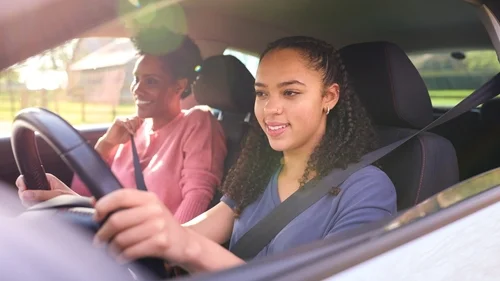
When it comes to learner’s permits, insurance works a bit differently. While you’re not legally required to have insurance for a teen with a learner’s permit, it’s important to inform your insurance company if your teen is learning to drive in your car.
If you don’t, and your teen has an accident, your insurance company might reject your claim or cancel your policy.
Usually, you add your teenager to your insurance as a listed driver once they get a provisional license, the first license that lets drivers under 18 in Texas drive on their own. Then, you can either add them to your policy or help them get their own.
Learner’s Permit and Auto Insurance in the Event of an Accident
If a student driver is practicing in a personal vehicle, like a parent’s car, they could be responsible for any damages they cause in an accident, just like any other driver, even if they only have a Texas learner’s permit.
In this situation, the parent’s car insurance policy would probably cover the damages if the student driver is listed on or covered by the policy, which is why communicating with your carrier is key.
Tips for Finding Auto Insurance for Learner’s Permit Drivers in Texas
If your home has a new driver using a Texas learner’s permit, while you may not need to get an auto insurance policy just yet, soon enough, they’ll need to have their own coverage.
A separate auto policy for a permit driver usually isn’t necessary, but newly licensed drivers require coverage and are going to face expensive premiums when they do enroll.
Managing risk is what insurance is all about and younger, inexperienced drivers are statistically more likely to get in an accident.
For this reason and more, elevated premiums are found in younger drivers but there are ways to save. Skip the auto insurance for a learner’s permit but save on premiums with these tips for drivers who are just getting started:
Keep Parents and Kids on the Same Policy
Adding kids to their parent’s auto insurance policy can save money because of the parents’ longer driving record and the potential discounts offered by carriers.
Depending on where you receive coverage, it may be the only option since some insurers don’t cover young drivers on their own policy.
The advantages of keeping kids and parents on the same policy include lower premiums, new discounts, simplified policy management, and establishing a coverage history.
If the child is 18 or older and has their own car, they can get their own policy, but it’s still usually expensive.
Depending on your needs, finances, and risk tolerance, keeping college students on the family auto insurance policy may be the best option. This applies even if they’re not driving at college to ensure coverage when they return home or drive elsewhere.
Practice and Maintain Good Grades
Some auto insurance companies offer discounts to young drivers with good grades, called good student discounts.
Many families searching for insurance for those with a driver’s permit have student drivers who can take advantage of these savings.
Carriers believe responsible students are also responsible drivers, and less likely to make claims.
Requirements vary by carrier and can include a minimum grade average, full-time enrollment, an age limit or standardized test scores. The Texas Department of Insurance notes that good grade discounts vary by company and that some can last for years.
How much of a discount you’ll receive depends on the carrier and you’ll need to keep up with your auto insurance company by providing proof that you are getting the grades you need to in order to qualify.
Plan Ahead and Compare Coverages for When They Have a License
Anyone driving in Texas must be able to show financial responsibility, which most people meet with liability coverage at or above the 30/60/25 minimum, and by planning ahead, you can compare your options and better assess your needs. Keep this in mind:
How the Texas learner license works
Texas uses a graduated driver license (GDL) program. According to the Texas Department of Public Safety, the first phase is the learner license:
- Learner license holders must be supervised by a licensed adult whenever they drive.
- Drivers under 18 must hold a learner license (or a hardship license) for at least six months before they can get a provisional license.
- A suspension or revocation during this phase extends the six-month holding period.
To move to a provisional license, DPS says a teen must be at least 16, complete a state-approved driver education course with classroom and behind-the-wheel instruction, and complete the Impact Texas Teen Driver program. Driver education schools and the parent-taught driver education option are overseen by the Texas Department of Licensing and Regulation.
What the TDI says about permits and insurance
The Texas Department of Insurance spells out the rule clearly: you aren’t legally required to have insurance for a teen with a learner’s permit, but you should always let your insurance company know if a teen is learning to drive in your vehicle. If you don’t tell your company you have a student driver and your teen gets in a wreck, TDI warns that the company could deny your claim, void your policy or refuse to renew it.
That’s why the practical answer for most Texas families is simple: call your agent when your teen gets a learner license. Insurers handle permit drivers differently, so ask how yours treats practice driving. That way you’ll know where you stand before anything happens.
Whose insurance pays if a permit driver crashes?
The policy on the car usually matters most. TDI’s auto insurance FAQ notes that someone who borrows your car with permission is usually covered by your policy if they have a license and don’t regularly borrow the car, unless your policy has a named driver exclusion. A teen in your household who practices regularly is a different situation, which is why telling your insurer matters. If your teen practices in a grandparent’s or friend’s car, check with that car’s owner and insurer first.
Why the permit stage matters for future premiums
The months on a learner license are the best time to build skills before your teen drives alone. The Centers for Disease Control and Prevention notes that crash risk is particularly high during the first months after a teen is licensed, and that the crash rate per mile driven is about 1.5 times as high for 16-year-old drivers as for 18- and 19-year-olds. The Insurance Institute for Highway Safety reports that the fatal crash rate per mile for drivers ages 16 to 19 is just over three times the rate for drivers 20 and older. Those numbers are why young drivers cost more to insure, and why a clean record from the start matters.
The National Highway Traffic Safety Administration encourages parents to set aside time for practice driving sessions, be good role models and not rely only on a driver education class to teach their teen to drive.
A practice plan for the permit months
- Start in empty parking lots, then move to quiet neighborhood streets.
- Add busier roads, highways and merging once basic skills are solid.
- Practice at night and in rain with a parent in the passenger seat before your teen faces those conditions alone.
- Practice in each vehicle your teen will drive once licensed.
- Talk through the provisional license rules your teen will follow until age 18.
Texas provisional license rules to plan around
Once your teen moves to a provisional license, DPS says these restrictions apply until age 18:
- No more than one passenger under 21 who isn’t a family member
- No driving between midnight and 5 a.m., except for work, school or emergencies
- No use of wireless communication devices while driving, including hands-free devices
This is usually when insurers require the teen to be listed on the policy. TDI notes that it’s usually cheaper to add a teen to your policy than to buy a separate policy, and that discounts for good grades, driver education, telematics programs and choosing an inexpensive or highly rated vehicle can help. Our guide on making car insurance cheaper for young drivers covers those options in detail.
An example timeline for a Texas family
Imagine a 15-year-old in Austin who finishes the classroom part of driver education and gets a learner license in March. The parents call their agent the same week to report a student driver in the household and ask how the policy treats permit drivers. Over the next six months, the teen practices with a parent in both family cars. Before the teen’s 16th birthday, the parents ask for quotes that include the teen as a listed driver, check which discounts apply and decide which car the teen will drive most. When the provisional license is issued, the teen is already on the policy.
Common mistakes
- Not telling the insurer about a permit driver. TDI warns this can lead to a denied claim or a voided policy.
- Waiting until after the license is issued to shop. Getting quotes in advance helps you budget and choose the right car.
- Letting the teen practice in a car without checking that car’s coverage.
- Lowering liability limits to offset the cost of a teen. A serious crash can exceed low limits quickly.
- Forgetting discounts. Ask about good student, driver education and telematics discounts.
Frequently asked questions
Do I have to buy a separate policy for my teen’s learner permit?
No. Texas doesn’t require insurance specifically for a permit holder, but you should tell your insurer that your teen is practicing in your car.
When does my teen need to be added as a driver?
TDI says a new teen driver in your household needs to be insured. In practice, that means listing your teen by the time they get a provisional license. Ask your insurer whether it wants permit drivers listed earlier.
Can my teen get a policy of their own?
Some can, especially at 18 with their own car, but TDI notes that adding a teen to a parent’s policy is usually cheaper. You can compare both options through our auto insurance page.
- Each carrier is going to provide different levels of discounts for young drivers and students.
- You will need to compare coverages among carriers to be sure you’re not only getting a competitive rate but also the right level of protection.
- Depending on who you enroll with, you may find better savings by bundling policies together under one carrier.
Comparing carriers can feel like a daunting task but it doesn’t have to be. Quickly compare auto insurance quotes online with our quote tool or contact us to find the right fit for your needs.
Sources:
1. Adding a teen driver to your insurance policy?, TDI. Accessed April 2024; link rechecked November 2026. Texas Department of Insurance (TDI tip article)
- Graduated Driver License (GDL) and Hardship License, Texas Department of Public Safety
- Driver Education and Safety, Texas Department of Licensing and Regulation
- FAQ: Auto insurance, claims, coverage issues, and more, Texas Department of Insurance
- Risk Factors for Teen Drivers, Centers for Disease Control and Prevention
- Fatality Facts: Teenagers, Insurance Institute for Highway Safety (IIHS)
- Teen Driving, National Highway Traffic Safety Administration
- Facts + Statistics: Teen drivers, Insurance Information Institute (Triple-I)
- Safe vehicles for teens, Insurance Institute for Highway Safety (IIHS)
Get a free Texas auto insurance quote
Ready for numbers? Fill out the short form below and a licensed Texas agent will compare carriers for you. It takes about two minutes, there is no obligation, and we never sell your information. Prefer the phone? Call 800-875-4711.